International SEO
International SEO: Why Optimising Only for Google Is Not Always Enough
Google dominates global search, but international visibility cannot be planned from one worldwide percentage alone. The right search strategy depends on the country, language, audience and platform.
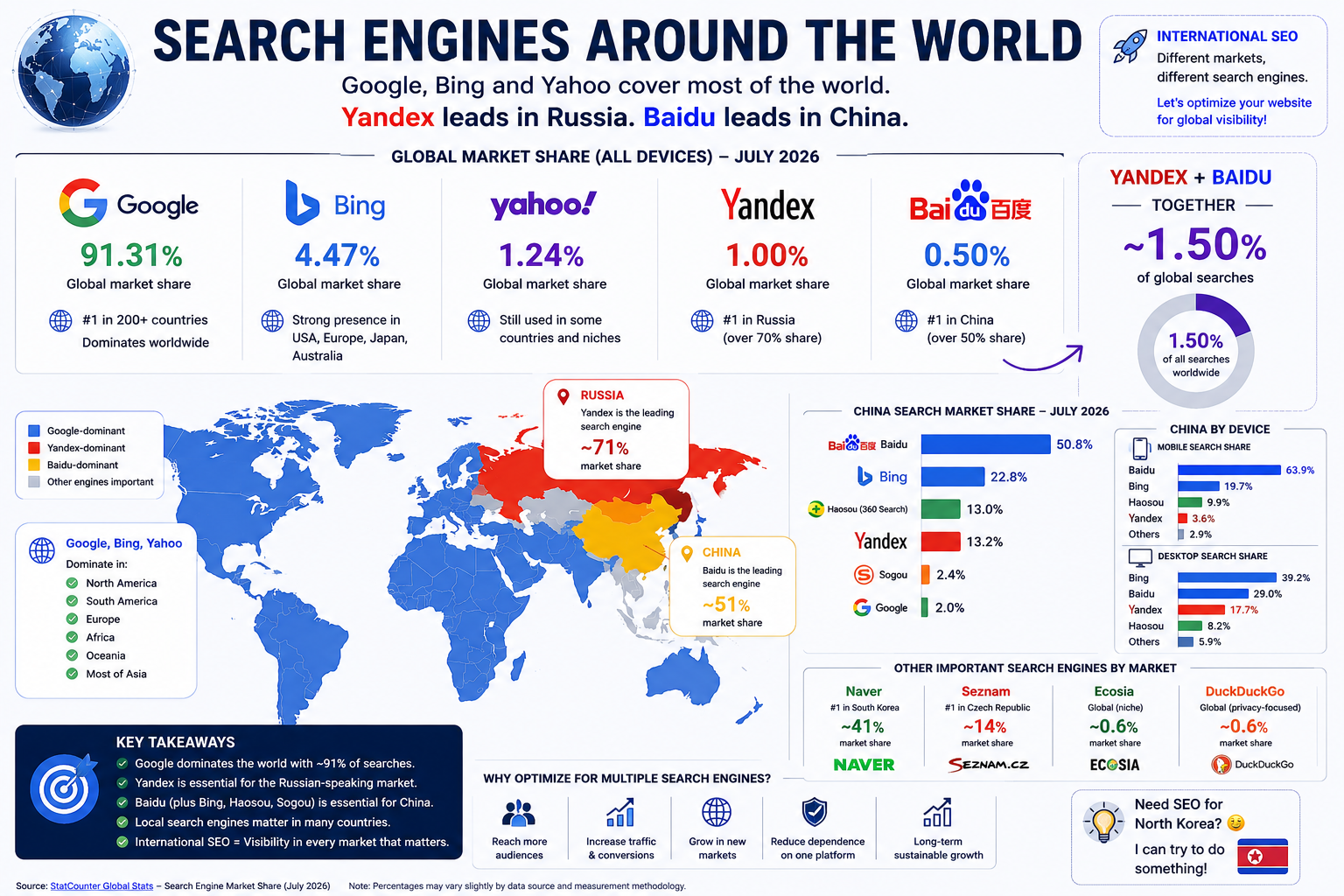
One global market, different search habits
Google is the dominant search engine worldwide, while Bing and Yahoo retain audiences in several markets. Regional behaviour is especially important: Yandex has a leading position in Russia, and Baidu is a major search platform in China.
This means that a multilingual website is not automatically an internationally optimised website. Translation is only one part of the work. Each language version also needs crawlable navigation, accurate metadata, canonical URLs, language alternates, locally relevant terminology and reliable search-engine verification.
Why regional engines matter
- Google: the primary global platform and the starting point for most international projects.
- Bing: relevant across Microsoft-powered search experiences and several desktop markets.
- Yandex: important for Russian-speaking audiences and supported by Yandex Webmaster and IndexNow.
- Baidu: requires specific attention when a business wants visibility in mainland China.
Optimising for several engines does not mean creating duplicate websites. It means building one technically sound site and then respecting the discovery, indexing and market requirements of each platform.
My practical international SEO workflow
- Create useful, accessible content in the correct language.
- Give every page one stable canonical HTTPS URL.
- Connect language versions with accurate
hreflangreferences. - Maintain a clean XML sitemap containing only indexable canonical pages.
- Verify the website in Google Search Console, Bing Webmaster Tools and Yandex Webmaster.
- Use IndexNow for genuinely created, updated or deleted URLs supported by participating engines.
- Measure results separately by country, language, query and search engine.